
Solitaire Odds: How Many Deals Can You Actually Win?
Short answer: It depends hugely on the game and on how you play. In FreeCell almost every deal can be won: of the original 32,000 numbered deals, only one cannot. In our Golf Solitaire we checked 2,000 deals per level by computer: with perfect play 93% of Easy deals can be won, 43.5% on Medium and 24.6% on Hard, but a player who simply plays any card that fits wins only 19%, 2.5% and 0.8%. Klondike sits in between, and Spider with four suits is the hardest of all.
- Solved games: tic-tac-toe, Connect Four, checkers
- Sudoku by the numbers
- The maths of shuffling
- Solitaire odds: how many deals can be won? (you are here)
"Can this deal even be won?" is the question every Solitaire player asks after a long losing streak. There are really two questions hidden in it. The first is whether a deal is winnable at all, by a player who could see every card and plan perfectly. The second is how often a normal player, who sees only the face-up cards and plays move by move, actually wins. The gap between those two numbers is the part of the game that is skill, and it is bigger than most people think.
Golf Solitaire: our own experiment
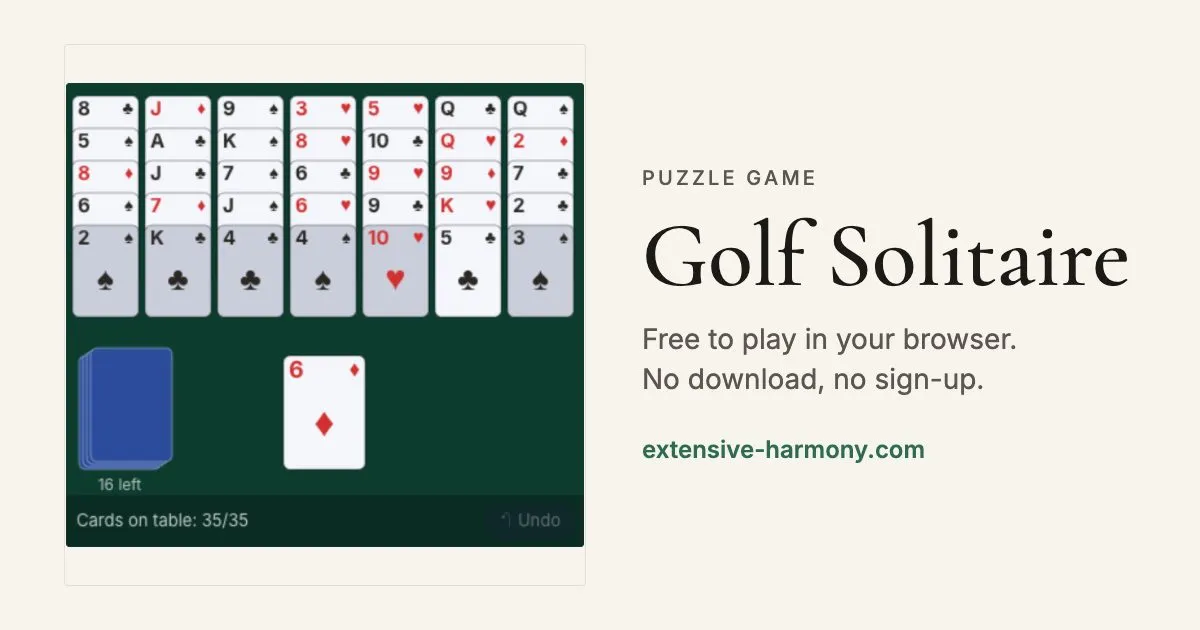
Golf is a perfect game for an experiment, because every card in the columns is face up and the rules are short. In our Golf Solitaire you have seven columns of five cards, one card on the pile and 16 in the stock. You may move the bottom card of any column onto the pile if it is one rank higher or lower, whatever the suit. When you are stuck, you turn a card from the stock. You win by clearing all 35 cards. The three levels change one rule each:
- Easy: Kings and Aces connect, so a 2 can go on an Ace, an Ace on a King and so on around the circle.
- Medium: no wrapping: nothing goes between King and Ace.
- Hard: no wrapping, and nothing at all can be played on a King until you turn a new card from the stock.
We wrote a short program that loads the game's own rules and deals 2,000 games per level exactly the way the game does. For each deal it checked two players:
- A perfect player, who sees every card, including the order of the stock, and tries every sequence of moves until it finds a win or proves there is none.
- A simple player, who plays any card that fits (from the column with the most cards left, when there is a choice) and turns a stock card only when stuck. This is roughly how most people play their first games.
| Level | Winnable with perfect play | Won by the simple player |
|---|---|---|
| Easy (K-A wraps) | 93.2% | 19.1% |
| Medium (no wrap) | 43.5% | 2.5% |
| Hard (nothing on a King) | 24.6% | 0.8% |
2,000 random deals per level. With this many deals each percentage is accurate to within about two percentage points.
Two things stand out. First, Golf is mostly a game of skill, not luck: on Easy, more than nine deals in ten can be won, yet playing without a plan wins fewer than one in five. Second, the Easy wrap rule is worth a lot. Removing the link between King and Ace roughly halves the share of winnable deals, because every King and Ace that turns up becomes a possible dead end.
The perfect player is not using any secret. It wins mostly by doing three things the simple player does not:
- It chooses which card to play, not just whether to play. When two columns offer a playable card, the right choice is the one that leaves the next card in a playable chain. 5-6-7-6-5 from different columns clears five cards with one stock card; picking the wrong 6 can stop the chain at two.
- It saves moves. Sometimes it is better not to play a card now, because it is the only link between two longer runs later.
- It watches the stock. With 16 stock cards for 35 table cards, every stock card has to be worth about two table cards. Turning one too early wastes it.
You cannot see the stock in the real game, but the first two habits alone close much of the gap. Before every move, look at all seven bottom cards and count how long a chain each choice would start.
FreeCell: almost every deal can be won
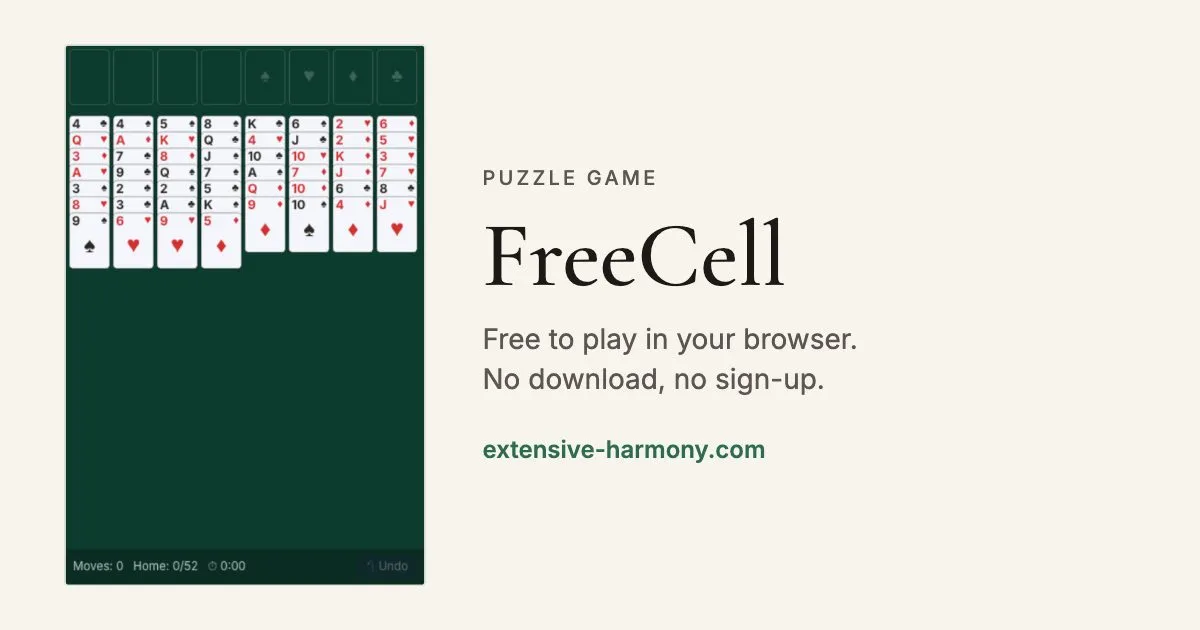
FreeCell is the opposite of Klondike: all 52 cards are dealt face up into eight columns, and you get four "free cells" to park single cards. With no hidden information, the result depends only on your planning. The numbers are famous: of the 32,000 deals in the original Microsoft version, only one, game 11982, has no solution. Among random deals in general, the unwinnable ones are a tiny fraction of a percent.
The free cells matter more than they look. The number of cards you can move as a group is (free cells + 1) × 2 for every empty column. With four empty free cells and no empty columns you can move five cards at once; with two free cells, only three. That is exactly how our FreeCell sets its levels: Easy has 4 free cells, Medium 3 and Hard 2, so Hard deals need far more careful planning. We measured it: of the same 1,000 random deals, at least 99.4% can be won with four free cells, 96.6% with three and 75.3% with two (see FreeCell win rate by free cells). The guide how to play FreeCell shows how to use the cells without filling them up.
Klondike: the classic, and a lot of hidden cards
Klondike, the game most people simply call Solitaire, is much harder to analyse, because 21 cards start face down and the stock order is unknown. Computer studies of "thoughtful" Klondike, an imaginary version where you can see every card, put the share of winnable deals at roughly four in five. A real player sees much less, so the share of games actually won is well below that, and it depends heavily on the rules.
Our Solitaire has three settings: Easy turns one card from the stock at a time, Medium three, and Hard three with only three passes through the stock. Turning three cards hides two of them under the third, so some cards you need stay out of reach; that is why draw-three Klondike is far harder than draw-one. Whatever the setting, the most valuable habit is to uncover face-down cards as early as possible: every hidden card turned up gives you information and new moves. Our Solitaire guide explains the order of priorities.
Spider: the hardest of the four
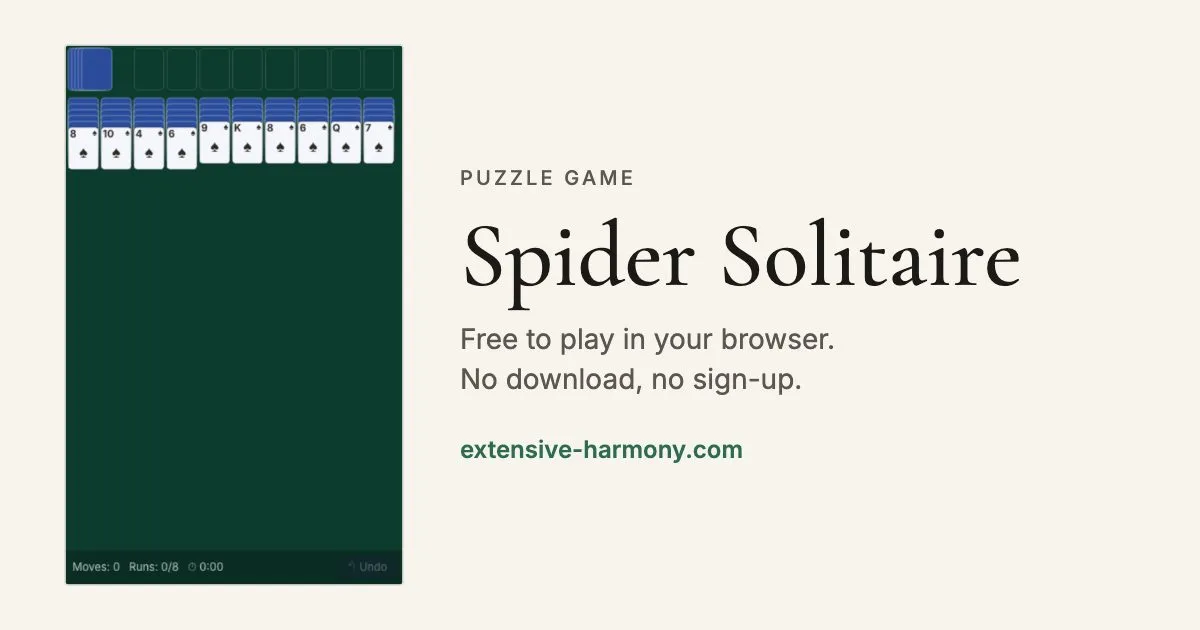
Spider uses two full decks in ten columns, with most cards face down. You can place any card on one a rank higher, but only runs of a single suit move together, and a full run from King to Ace leaves the table. The number of suits changes everything. With one suit, every run can move, and a careful player wins most games. With two suits, mixed runs start to block you. With all four suits, most deals end with the table clogged by runs you cannot move, and even very good players win only a minority of games. Our Spider Solitaire uses one suit on Easy, two on Medium and four on Hard. Learn on one suit first; our Spider guide covers the habits that transfer.
Luck or skill?
| Game | Hidden cards | Winnable deals | Where skill matters most |
|---|---|---|---|
| FreeCell | None | Almost all | Planning several moves ahead, keeping free cells empty |
| Golf | Only the stock | 93% (Easy) to 24.6% (Hard) | Choosing which card to play, building long chains |
| Klondike | 21 face-down cards and the stock | Roughly 80% even with full knowledge | Uncovering hidden cards early, draw-one vs draw-three |
| Spider (4 suits) | Most of the table | Low for real players | Keeping runs in one suit, using empty columns |
The pattern is clear: the more cards you can see, the more the result depends on you. A losing streak in FreeCell or Golf is almost always a sign of moves that could have been better. In Klondike and four-suit Spider, some deals really cannot be won, and no amount of skill changes that. Tile solitaire can be built to avoid the problem: our Mahjong solitaire, where every board can be cleared, deals each board backwards from an empty table.
Did you know?
- On Hard, our simple player won fewer than one deal in a hundred (0.8%), yet about one deal in four (24.6%) could have been won. That gap, thirty times over, is the value of planning.
- FreeCell was first written by Paul Alfille in 1978 for the PLATO computer system, years before it came with Windows; see the history of puzzle and casual games.
- Because every card game here uses a fair Fisher–Yates shuffle, each deal is equally likely; the odds above are the real odds of the game, not of a rigged dealer. More in the maths of shuffling.
This is the last part of our series on the maths of classic games. Start from the beginning with Part 1: Solved games.