
The Arcade Golden Age: Pong, Space Invaders and Pac-Man
Short answer: Arcade games began in 1971, when two teams tried to sell Spacewar! as a coin-operated machine. Atari's Pong (1972) was the first big hit because anyone could understand it in seconds. Breakout (1976) and Space Invaders (1978) added targets to destroy, Asteroids (1979) brought vector graphics and physics, and Pac-Man (1980) gave games a character and enemies with personalities. Together they invented high scores, lives and rising difficulty, the building blocks of nearly every game since.
- The first video games (1947–1962)
- The arcade golden age (1971–1982) (you are here)
- Video games come home (1972–1989)
- From Tetris to 2048: puzzle and casual games
At the end of the 1960s, the only way to play a video game was to know someone with a key to a university computer room. Ten years later, video games stood in bars, bowling alleys, cafés and shopping centres around the world, and a single good machine could earn back its price in weeks. The trick that made it possible was simple: replace a computer costing as much as a house with a few cheap chips, and make the game so easy to learn that a stranger would put a coin in without reading the instructions.
1971: two attempts to sell Spacewar!

In September 1971 two Stanford University graduates, Bill Pitts and Hugh Tuck, installed Galaxy Game in the student union: a version of Spacewar! running on a real minicomputer, at ten cents a game. Students loved it, but the hardware was far too expensive to copy, so only a couple were ever built.
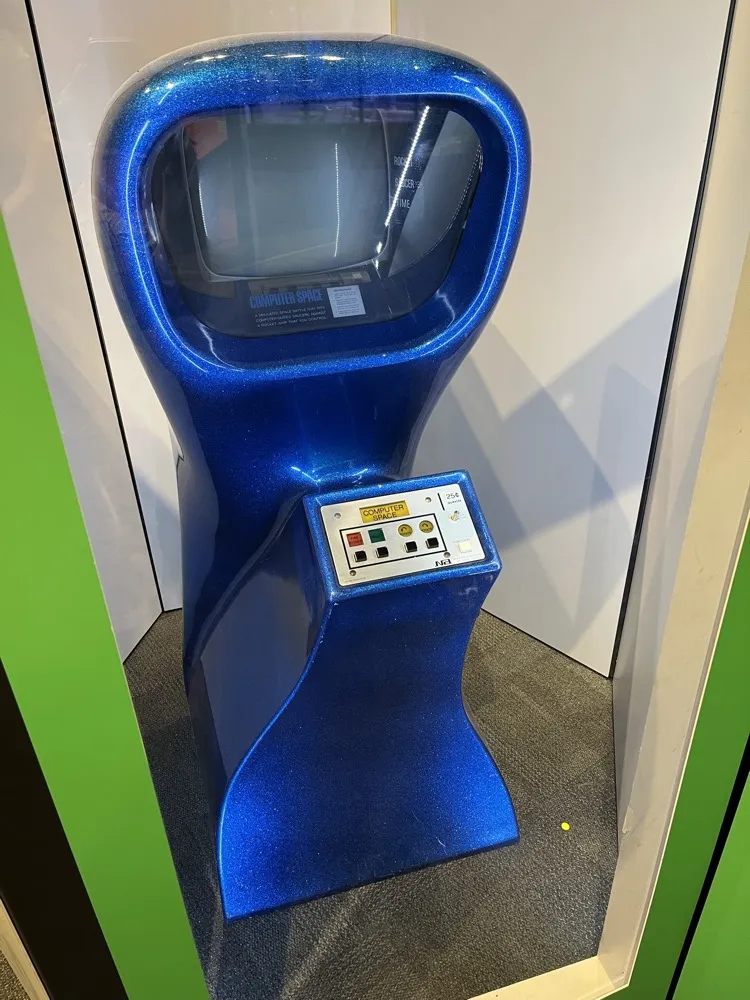
A few months later Nolan Bushnell and Ted Dabney, working with the company Nutting Associates, released Computer Space. Their insight was to throw the computer away altogether: the game was built from simple logic chips and a modified black-and-white television set, which made it cheap enough to manufacture. It came in a striking, curved fibreglass cabinet and sold around 1,500 units. But it was hard to play. You had to manage rotation, thrust and firing while dodging two flying saucers, and people who had never seen a video game walked away confused. Bushnell's lesson was clear: the next game had to be simple.
1972: Pong
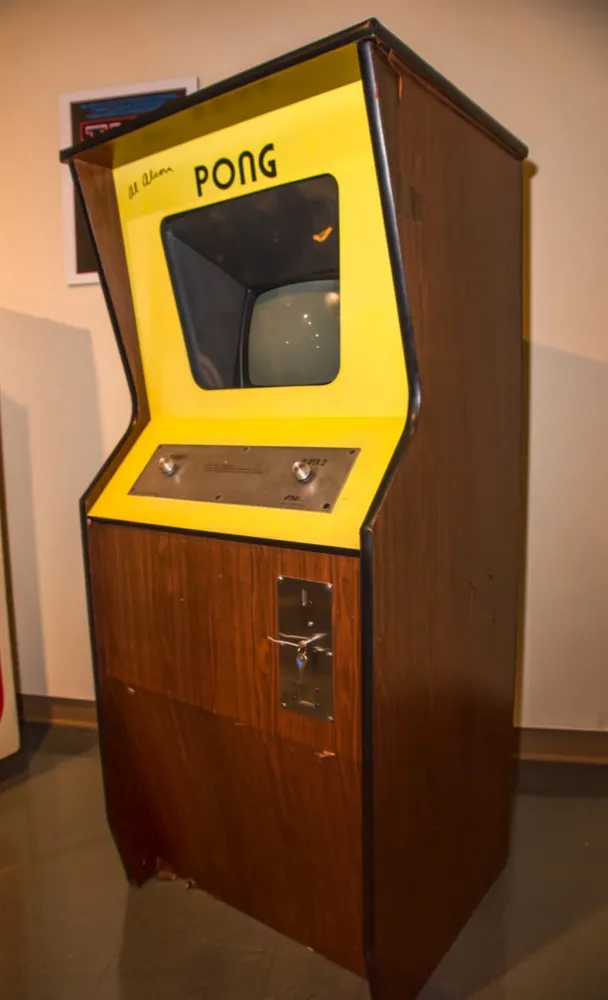

In June 1972 Bushnell and Dabney founded Atari. As a warm-up exercise, Bushnell asked newly hired engineer Allan Alcorn to build a simple tennis game; he had seen the table tennis game on the Magnavox Odyssey home console at a demonstration a few weeks earlier. Alcorn added touches that turned the exercise into something special:
- The paddle was split into segments, so hitting the ball with the edge sent it off at a sharper angle than hitting it with the centre. This gave players control.
- The ball sped up the longer a rally lasted, so every point ended eventually, and quickly enough to make you put in another coin.
- Simple beeps from the existing circuits gave every hit a sound.
The prototype went into Andy Capp's Tavern in Sunnyvale, California, in 1972. After a short while the owner called to say it had stopped working; when Alcorn opened it, the coin box was so full of quarters that it had jammed. The cabinet's only instruction read "Avoid missing ball for high score".
Pong was copied by dozens of companies, since a game idea could not be protected. Magnavox, whose Odyssey had the patents on playing games on a television, sued; Atari settled in 1976 and became a licensee. By then, the arcade video game was an industry.
Pong's rules have not aged at all. Try our Paddle Ball to feel how the angle of each hit matters, and read our Pong tips for how to aim with the edge of the paddle.
1976: Breakout
Atari's next idea, from Nolan Bushnell and Steve Bristow, was a one-player Pong: instead of an opponent, you knock a ball into a wall of bricks. Steve Jobs, then working at Atari, took on the prototype and brought in his friend Steve Wozniak, who designed it in just a few days using remarkably few chips. Atari's own engineers found the design too clever to manufacture and rebuilt it, but the game was a success. The monitor was black and white; the coloured rows of bricks came from strips of coloured film stuck over the screen.
Wozniak later said that building Breakout influenced the Apple II computer he designed in 1976 and 1977, which gained colour graphics and sound partly so that games like it could be written in software. You can play a modern take in our Brick Buster, with tips in how to clear every level.
1978: Space Invaders
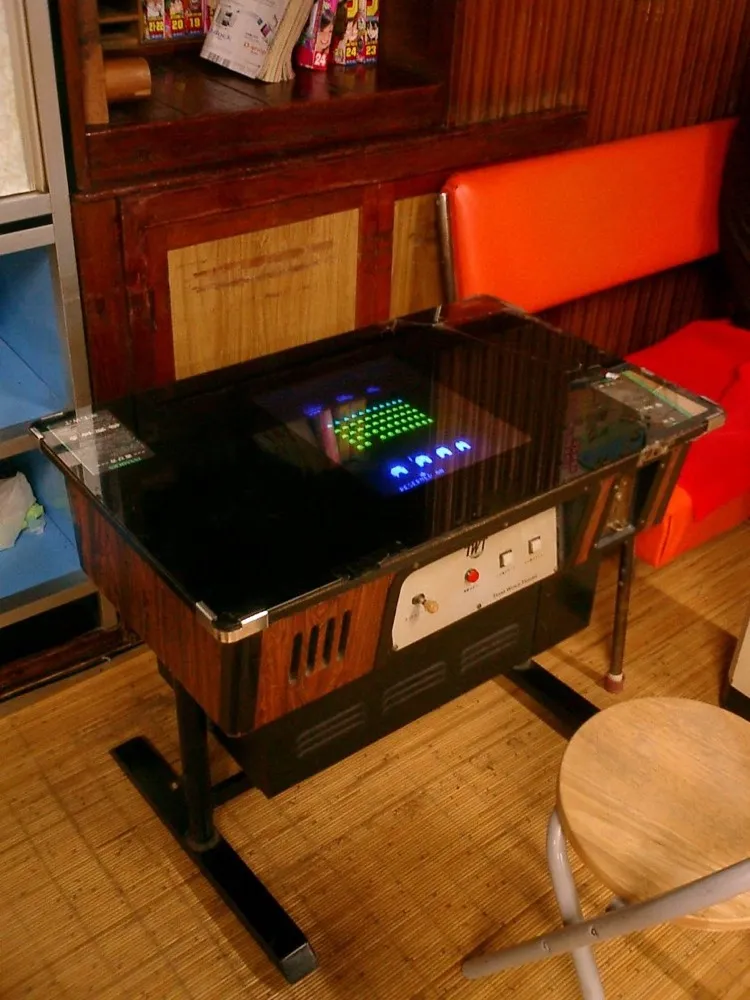

Tomohiro Nishikado at the Japanese company Taito designed both the game and the hardware for Space Invaders. Inspired partly by Breakout's rows of targets, he replaced the bricks with marching aliens that fire back. Several of its features became standard:
- The enemies attack you. Earlier games were about scoring; this one was about surviving.
- The pace speeds up. The fewer aliens remain, the faster they move. This started as a hardware limit: with fewer aliens to draw, the processor could move them more quickly. Nishikado liked the tension it created and kept it.
- A high score that stays. The best score was shown on screen for the next player to beat, which turned a solo game into a competition among strangers.
- Shields that wear away as both sides shoot them, so your cover disappears as the game goes on.
Space Invaders was an enormous success in Japan and, licensed to Midway, in the United States. Its marching aliens and heartbeat-like sound effect, which speeds up with the aliens, are still instantly recognisable.
1979: Asteroids

Atari's Asteroids, designed by Lyle Rains and programmed by Ed Logg, borrowed Spacewar!'s spaceship: you rotate, thrust and drift, with a hyperspace button for emergencies. Instead of a TV picture, it used a vector display that drew sharp, glowing lines, perfect for a ship and tumbling rocks. Big asteroids split into smaller, faster ones when you shoot them, so the screen gets more dangerous the more you fire. It became Atari's best-selling arcade game, with more than 70,000 cabinets built.
The same rotate-and-thrust controls are in our Space Rocks, and our Space Rocks tips explain why the best players barely use the thruster.
1980: Pac-Man
By 1980 arcades were full of shooting games, and Toru Iwatani at Namco wanted something different that would also appeal to people who did not like violent games. His answer was a character who eats. Pac-Man (released in Japan as Puck Man) moves through a maze eating dots while four ghosts hunt him, and the shape famously came, at least in part, from a pizza with one slice taken out.
The ghosts were the real innovation. Each one follows a different rule:
- Blinky (red) heads straight for Pac-Man.
- Pinky (pink) aims at a spot a few tiles in front of him, trying to cut him off.
- Inky (cyan) uses both Pac-Man's position and Blinky's, which makes him the hardest to predict.
- Clyde (orange) chases when he is far away and wanders off when he gets close.
Together these simple rules make the ghosts feel like they are cooperating. Eating a power pellet turns the tables for a few seconds and the ghosts run away. Pac-Man soon appeared on lunch boxes and T-shirts, and in 1982 got his own Saturday-morning cartoon: a game character had become a pop-culture star. The game has 255 playable levels: on level 256 the level counter runs out of room, and half the screen fills with garbled symbols, making it impossible to finish.
1981: Donkey Kong and the arrival of stories
A year later Nintendo's Donkey Kong, the first game designed by Shigeru Miyamoto, told a small story with short scenes between levels: a carpenter called Jumpman climbs ladders and jumps over barrels to rescue a woman from a giant ape. Jumpman was soon renamed Mario. Donkey Kong was one of the first games where jumping was the main skill, the start of the platform game genre.
What the arcades taught every later game
Arcade designers had one goal: make a newcomer understand the game in a few seconds, then keep them playing long enough to put in another coin, but not forever. The tools they invented to do that are everywhere today:
- Lives: a few chances instead of instant game over, so a first-timer gets a fair try.
- Rising difficulty: faster balls, faster aliens, more asteroids. The game teaches you, then tests you.
- High scores: a reason to play again, and to play better than the last person.
- Attract mode: a demo that plays itself on screen to show passers-by what to do.
- Short sessions: a game that lasts a few minutes. This is exactly why arcade classics work so well as quick browser games.
The golden age faded around 1983, as arcades multiplied, the novelty wore off and home consoles brought the same games into the living room, with mixed results.
Did you know?
- Computer Space appeared as a futuristic prop in the 1973 film Soylent Green.
- Pong's paddles could not reach the very top of the screen, a quirk of the original circuit that players learned to exploit.
- In Space Invaders, the "mystery ship" that flies across the top is worth more points if you hit it with the right shot count, a secret that skilled players memorised.
Next: Part 3: Video games come home, from the Magnavox Odyssey and Atari 2600 to the 1983 crash and the NES.