
Video Games Come Home: Odyssey, Atari 2600, the Crash and the NES
Short answer: The first home video game console, the Magnavox Odyssey, went on sale in 1972, based on Ralph Baer's idea of playing games on an ordinary television. Home Pong (1975) made it a hit, and cartridges, made popular by the Atari 2600 (1977), let one machine play many games. Too many consoles and too many poor games caused the North American crash of 1983. Nintendo's NES (1985 in the US) revived the market with strict quality control, and the Game Boy (1989) put games in every pocket.
- The first video games (1947–1962)
- The arcade golden age (1971–1982)
- Video games come home (1972–1989) (you are here)
- From Tetris to 2048: puzzle and casual games
While arcades were filling with Pong machines, the bigger prize was already obvious: almost every home had a television, and most of the time it was showing nothing worth watching. Whoever could turn that screen into a game board would reach millions of people who never set foot in a bar or an arcade. Getting there took fifteen years, one spectacular collapse and a Japanese playing-card company.
1966–1972: Ralph Baer and the Magnavox Odyssey
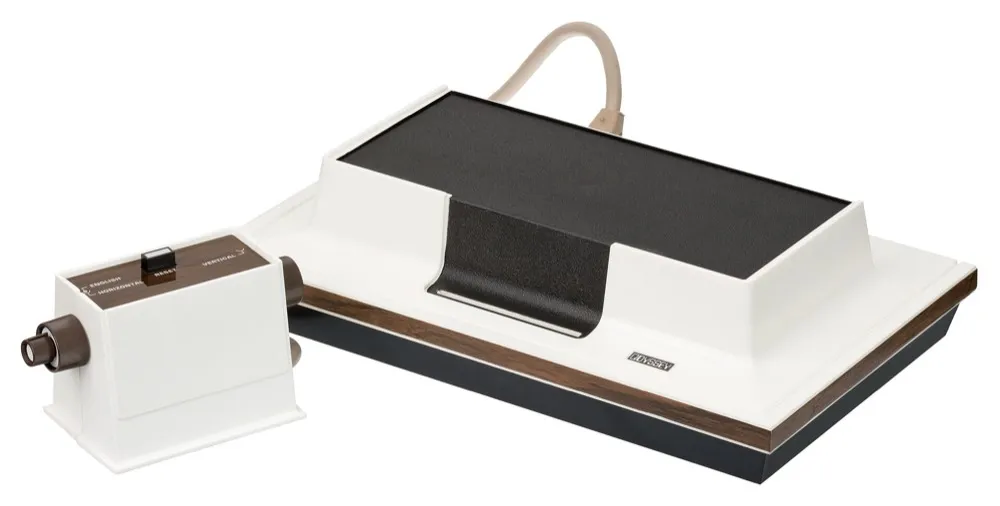

In 1966 Ralph Baer, an engineer at the American defence electronics company Sanders Associates, wrote down an idea: a box that plugs into a normal TV set and lets people play games on it. With colleagues Bill Harrison and Bill Rusch he built a series of prototypes, the last of which became known as the "Brown Box". Sanders licensed it to the television maker Magnavox, which released it in 1972 as the Odyssey.
The Odyssey is surprisingly primitive by later standards. It could only draw a few white squares and a vertical line. There was no sound and no score on screen; players kept score on paper. To make different games, it came with coloured plastic overlays that stuck to the TV screen, plus dice, cards and play money, so a "game" was half video and half board game. Plug-in cards rewired the circuits to switch between games. Magnavox sold around 350,000 of them, held back partly because many shoppers believed it only worked with Magnavox televisions.
Its table tennis game, however, changed history: Nolan Bushnell saw it at a demonstration in 1972, and Atari's Pong followed weeks later. Baer later received the US National Medal of Technology and is often called the father of home video games.
1975: Pong comes home
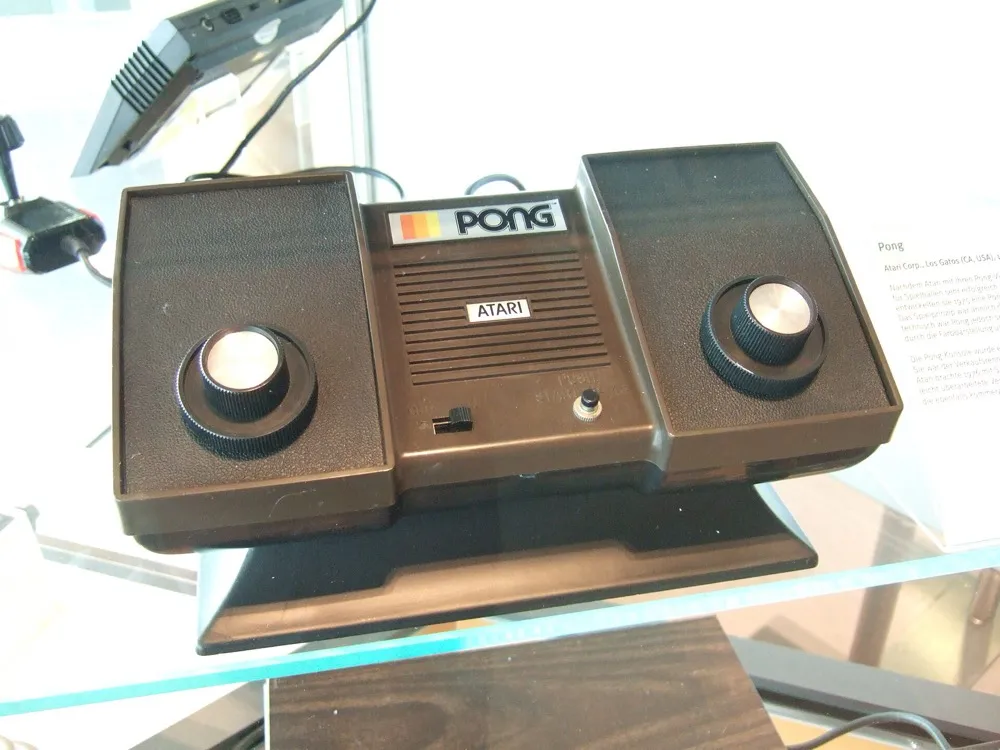

In 1975 Atari packed Pong into a single chip and sold a home version through the American department store Sears. Unlike the Odyssey, it had sound and an on-screen score, and it was a huge Christmas success. Within two years dozens of companies sold their own "Pong boxes", many built around one inexpensive chip that played several bat-and-ball games. The market soon flooded, an early warning of what would happen again in 1983.
1976–1977: cartridges and the Atari 2600
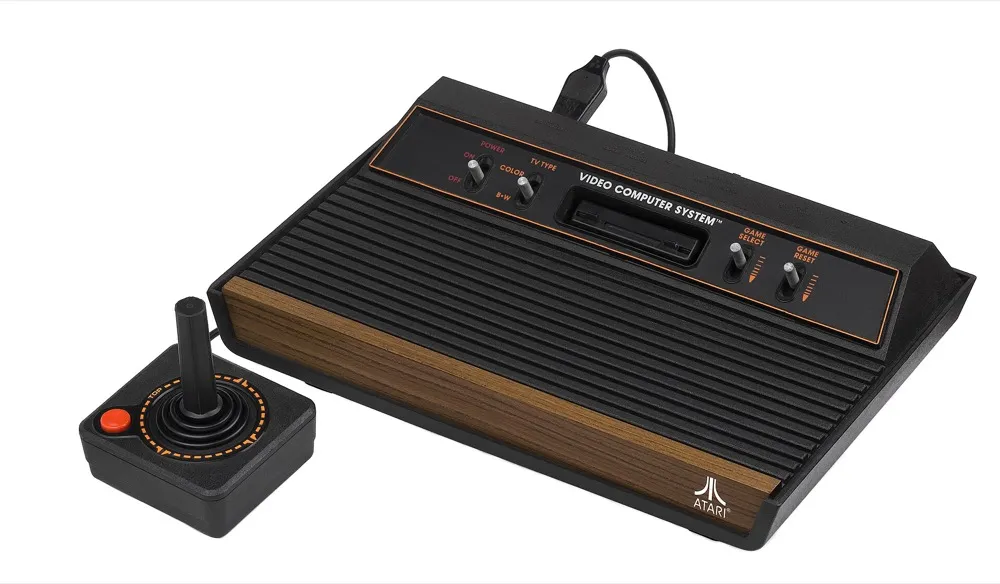

A machine that plays one game gets boring. The solution was the cartridge: a plastic case holding the game program on a chip, which you swap like a tape. The Fairchild Channel F, whose development was led by engineer Jerry Lawson, introduced it in 1976. A year later Atari released the Video Computer System, later renamed the Atari 2600, and it became the console that defined the era.
The 2600 was tiny on the inside: it had just 128 bytes of working memory, less than the text of a single SMS message. It could not even store a full picture of the screen, so programmers had to "race the beam", changing the image line by line as the television drew it. Some of what they achieved with this machine still amazes engineers today. A few milestones:
- Space Invaders (1980) was the first officially licensed arcade game for a home console, and people bought the console just to play it at home.
- Activision was founded in 1979 by four Atari programmers who wanted credit and royalties for their games, the first company to make games for someone else's console.
- Adventure (1979), by Warren Robinett, hid a secret room with his name in it, because Atari did not credit its programmers. It is the most famous early "Easter egg" in a game.
1978: Simon, a toy that taught memory
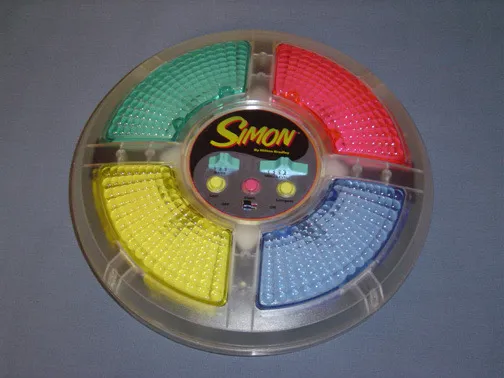

Not every early electronic game needed a TV. Simon, designed by Ralph Baer together with Howard J. Morrison and sold by Milton Bradley in 1978, was a round box with four coloured buttons. It played a sequence of lights and tones, you repeated it, and each round it added one more step. It was inspired by an Atari arcade game called Touch Me, but its simple shape and sounds made it a best-selling toy for years. Simon is a pure memory test, and it is still a great one; try our Color Echo and the tricks in how to remember longer sequences.
Handhelds and home computers
Two other kinds of machine shaped the early 1980s. In 1980 Nintendo engineer Gunpei Yokoi created the Game & Watch, pocket games with a calculator-style screen, reportedly after watching a bored commuter play with a calculator on a train. The 1982 Game & Watch version of Donkey Kong introduced the cross-shaped direction pad, which almost every controller still uses.
At the same time, home computers such as the Apple II (1977), the ZX Spectrum and the Commodore 64 (both 1982) brought games into homes along with homework and spreadsheets. Magazines printed games as pages of program code that readers typed in themselves, and teenagers in their bedrooms began writing and selling games of their own, especially in Britain.
1983: the crash
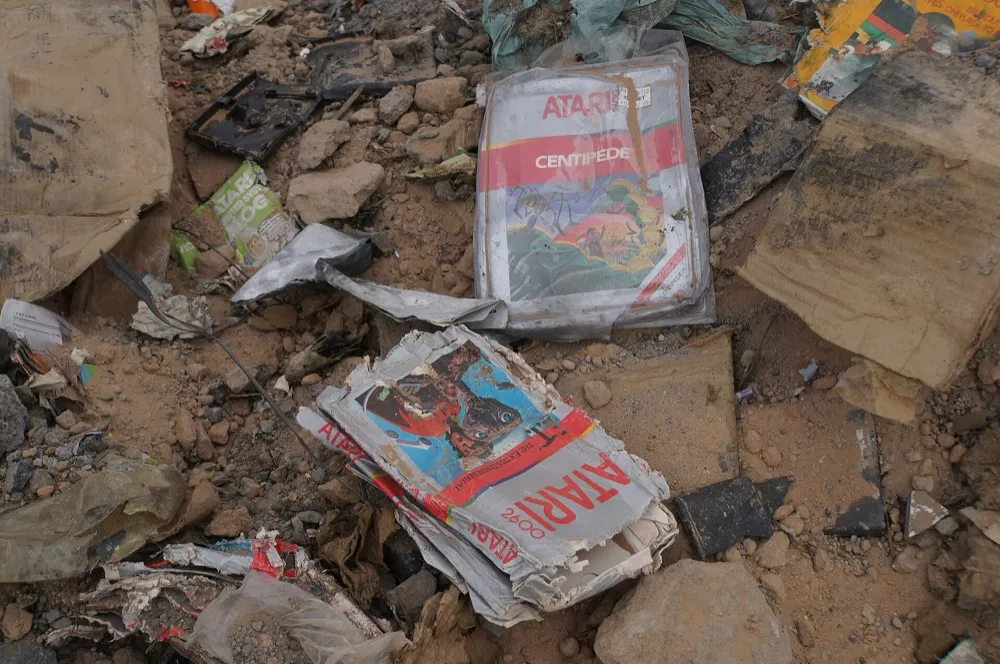

By 1982 the American market was crowded with consoles, among them the Atari 2600, Mattel's Intellivision and the ColecoVision, and with hundreds of cartridges, many of them rushed and poor. Companies with no experience of games, even the food company Quaker Oats, set up games divisions. Shops could not sell everything, so they cut prices, which made it hard for good games to earn back their cost.
Two famous Atari games became symbols of the problem. The 2600 version of Pac-Man (1982) looked and sounded far worse than the arcade game. E.T. the Extra-Terrestrial was made in about five weeks to be in shops for Christmas 1982, and many players found it confusing. Atari had produced far more cartridges than it could sell. In September 1983 trucks carried unsold games and hardware to a landfill in Alamogordo, New Mexico. For years the story was treated as an urban legend, until a documentary team dug up the site in 2014 and found the cartridges.
In 1983 and 1984 sales of home video games in North America collapsed. Many companies went bankrupt, and shops decided video games had been a fad. Home computers, which could also run games, kept selling, and in Japan and Europe the market carried on.
1983–1985: Nintendo rebuilds the market
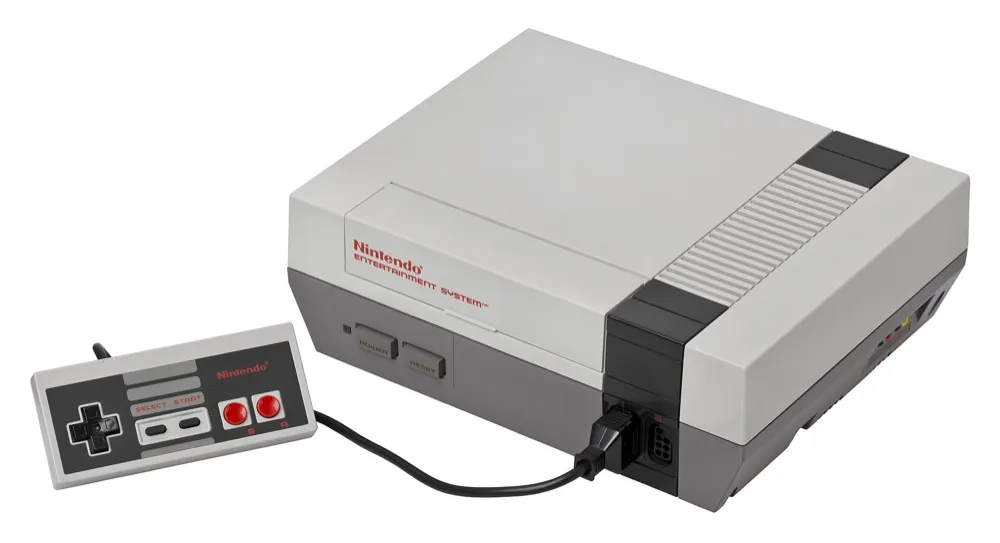

In July 1983 Nintendo released the Family Computer, or Famicom, in Japan. When it brought the console to the United States, American shops did not want to hear about video games, so Nintendo redesigned it: a grey box loaded from the front like a video recorder, renamed the Nintendo Entertainment System, and launched in New York in October 1985 together with a small robot accessory, R.O.B., so stores would treat it as a toy.
The bigger change was control. Nintendo added a lockout chip so that only approved cartridges would run, limited how many games each company could release, and printed a "seal of quality" on licensed games. After the flood of bad games in 1983, this was exactly what shops and parents wanted. Then came Super Mario Bros. (1985), with smoothly scrolling worlds, hidden blocks and secret pipes. It showed what a home game could be when it was designed for long play at home rather than short arcade sessions.
1989: the Game Boy
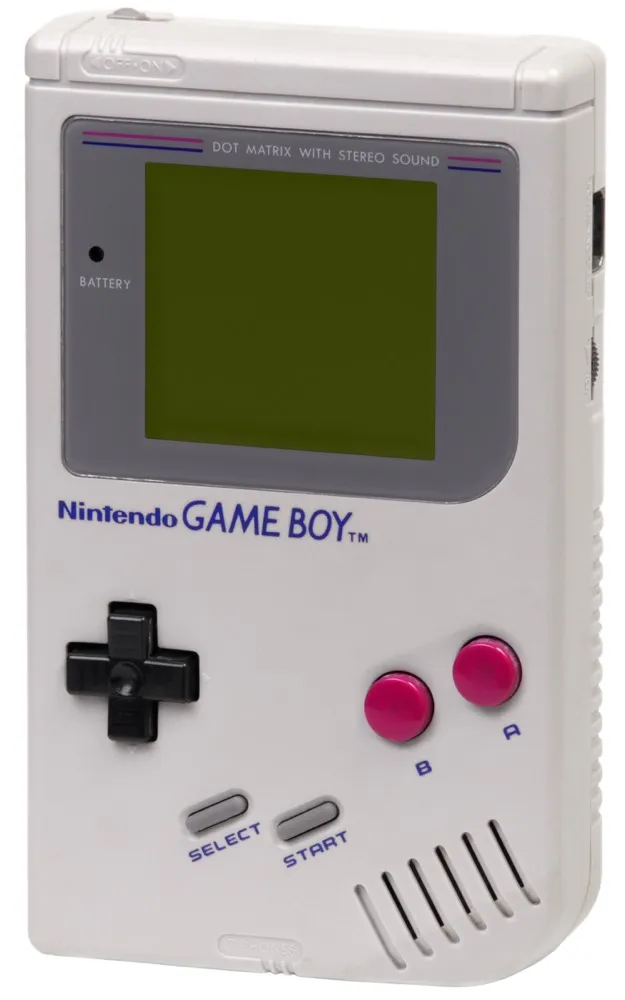

Gunpei Yokoi's team at Nintendo released the Game Boy in 1989. Its green-tinted screen was crude even then, but it was tough, cheap and ran for many hours on AA batteries. In North America and Europe it came with Tetris, a puzzle game that anyone could pick up, from children to their grandparents. That pairing is a story of its own, told in the last part of this series.
What the home era changed
- Longer games. Without a coin slot, a game no longer needed to end in three minutes, so designers built worlds, saves and secrets.
- Games as products, not machines. Cartridges separated the game from the hardware, which created game publishers and developers as we know them.
- Quality matters more than quantity. The crash showed that a flood of bad games could destroy a whole market.
- Everyone plays. Simon, Pong and the Game Boy reached people who would never enter an arcade, the same audience that plays quick browser and phone games today.
Did you know?
- The Atari 2600 stayed on sale until 1992, fifteen years after its launch.
- Ralph Baer kept the original Brown Box prototype, and it is now in the Smithsonian's National Museum of American History.
- Jerry Lawson, who led the Channel F cartridge console, was one of very few Black engineers in the industry at the time.
Next: Part 4: From Tetris to 2048, the story of the quiet puzzle and casual games that everyone ends up playing.