
The First Video Games: From OXO to Tennis for Two and Spacewar!
Short answer: The first video games were built in laboratories, not sold in shops. Bertie the Brain (1950) played tic-tac-toe with light bulbs, OXO (1952) put tic-tac-toe on a computer screen in Cambridge, Tennis for Two (1958) let visitors to a US lab hit a ball across an oscilloscope, and Spacewar! (1962) became the first game copied from computer to computer. Which one is "the first" depends on what you count as a video game, and each of them invented something every game still uses.
- The first video games (1947–1962) (you are here)
- The arcade golden age (1971–1982)
- Video games come home (1972–1989)
- From Tetris to 2048: puzzle and casual games
Nobody in the 1950s set out to start an industry. Computers filled whole rooms, cost more than a house and belonged to universities, armies and research labs. The people who wrote the first games were scientists and students who wanted to show what their machines could do, or simply to have some fun with them after hours. None of the four games below was ever sold, and three of them were switched off within a year or two. Yet between them they introduced a screen you react to, a computer opponent, real-time physics and two players fighting for the same controls.
What counts as the first video game?
Historians argue about this because the early machines were so different from what we play today. A useful test has three parts: the game is played on a screen that changes as you play, it reacts to your input, and it is run by electronics rather than mechanics. Pinball fails the first and last test; a chess computer that prints its moves fails the first. As you will see, each early game passes some of the tests and not others, which is why there is no single winner.
1947: the game that was only a patent
The earliest known design is the "cathode-ray tube amusement device", patented in the United States by Thomas T. Goldsmith Jr. and Estle Ray Mann (filed in 1947, granted in 1948). The player turned knobs to steer a glowing dot, meant to be a missile, towards targets drawn on a clear sheet placed over the screen. There was no computer inside, the targets were not part of the picture at all, and no one ever bought one: as far as anyone knows, it was never made beyond a prototype. It matters because it shows the idea of "playing with a screen" existed almost as soon as screens did.
1950–1951: games built to show off a computer
Bertie the Brain stood about four metres tall at the 1950 Canadian National Exhibition in Toronto. It was built by engineer Josef Kates to demonstrate his Additron vacuum tube, and it played tic-tac-toe against visitors on a grid of light bulbs. The difficulty could be adjusted, so the machine could be made to lose now and then and keep the crowd happy. After the exhibition it was taken apart.
A year later, at the 1951 Festival of Britain, the British company Ferranti showed Nimrod, a computer designed by John Bennett to play the old matchstick game of Nim on a panel of lights. Like Bertie, Nimrod was a showpiece: its job was to prove that a computer could follow rules and make decisions, and a game was the easiest way to show that to the public.
Neither machine had a video screen, so neither is usually called a video game. But they established something important: the very first thing people wanted to do with a computer in public was to play against it.
1952: OXO, tic-tac-toe on a screen
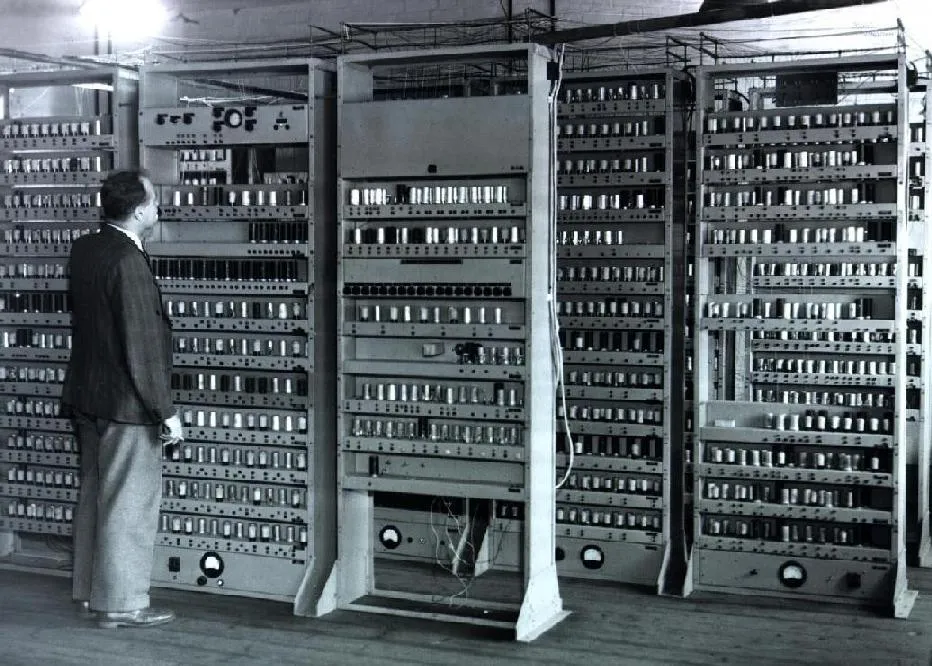

In 1952 Alexander "Sandy" Douglas, a PhD student at the University of Cambridge, was writing a thesis about how people and computers interact. To demonstrate it he wrote OXO, a game of noughts and crosses (tic-tac-toe) for EDSAC, one of the first computers able to store its program in memory. EDSAC had small round cathode-ray tubes that normally showed the contents of its memory; Douglas used one of them, a grid of 35 × 16 dots, to draw the board.
The controls were unusual: you chose your square by turning a rotary telephone dial, with the numbers 1 to 9 matching the nine cells. The computer could play a perfect game, which in tic-tac-toe means the best a human could do was draw. That is still true today: if both sides play correctly, every game ends in a draw, as we explain in how to win (or never lose) at tic-tac-toe.
OXO passes the "screen" and "input" tests, which is why it is often called the first video game with graphics. But only people with access to the Cambridge computer lab could ever play it, and it was written to make a point about research, not to entertain.
1958: Tennis for Two, the first game made for fun
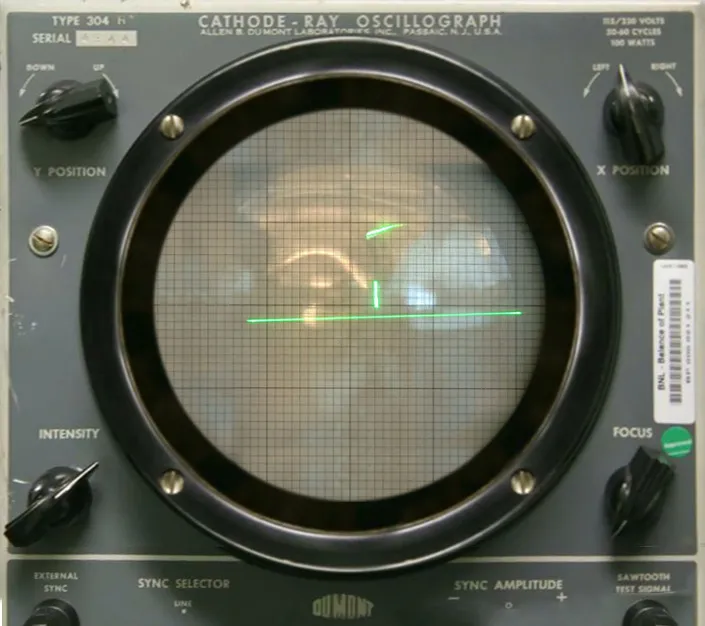

Brookhaven National Laboratory in New York held a visitors' day every autumn, and physicist William Higinbotham, head of its instrumentation division, thought the static displays of equipment were dull. In October 1958 he designed a game that visitors could actually play, and technician Robert Dvorak built it in a few weeks. They called it Tennis for Two.
An analog computer calculated the path of the ball, including gravity, and drew it on a small oscilloscope screen as a side view of a tennis court: a long line for the ground, a short one for the net. Each player had a box with a knob to choose the angle of the shot and a button to hit the ball. Hit it too low and the ball struck the net; get the timing right and it arced over to your opponent's side. Hundreds of visitors queued to play it, and for the 1959 visitors' day it returned with a larger screen and settings that imitated the gravity of the Moon and Jupiter.
After that it was dismantled and the parts were reused for lab work. Higinbotham never patented it; for him it was a way to make a science open day more interesting. He is better remembered for his work on nuclear non-proliferation: he had built electronics for the Manhattan Project and later became the first chairman of the Federation of American Scientists.
Tennis for Two is the strongest candidate for "first video game made purely to entertain". It had real-time motion, physics and two human players, the same recipe Pong used fourteen years later, only viewed from above. You can see how little the idea has changed in our Paddle Ball, a free Pong-style game.
1962: Spacewar!, the first game that spread
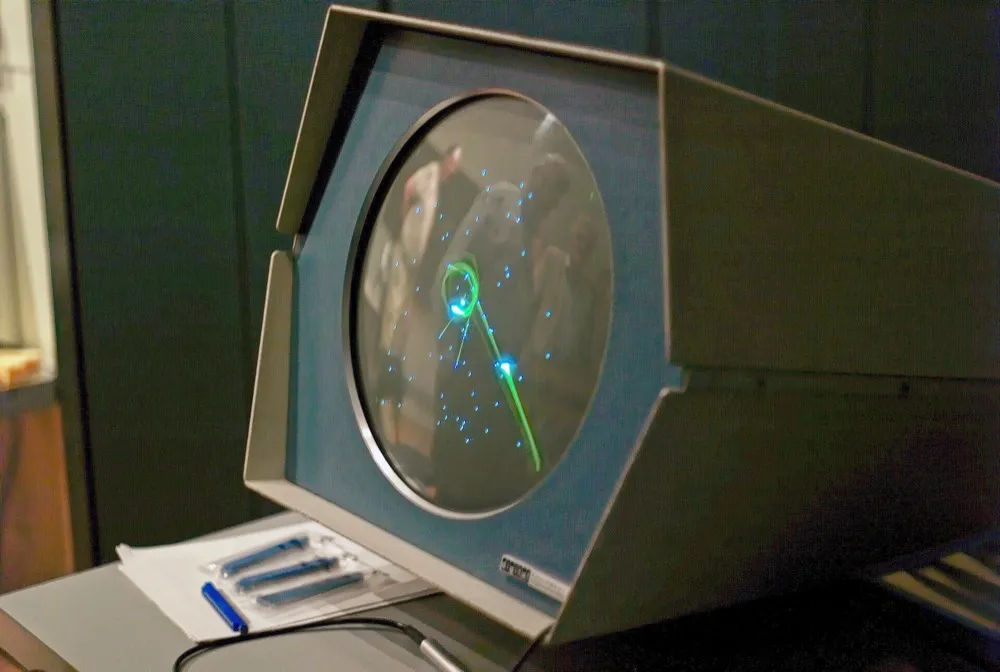

In 1961 the Massachusetts Institute of Technology received a PDP-1 from the Digital Equipment Corporation, a computer with a proper screen that students could use directly instead of handing in punched cards. Steve Russell, Martin Graetz and Wayne Wiitanen, fans of space adventure novels, decided the best demonstration of the new screen would be a space battle. Russell wrote most of the first version, which was running in early 1962.
Spacewar! puts two spaceships, the "needle" and the "wedge", on the screen. Each player can rotate, fire thrusters and launch torpedoes, with limited fuel and ammunition. Other students kept adding to it:
- Peter Samson wrote the "Expensive Planetarium", a scrolling starfield drawn from real star charts.
- Dan Edwards added a star in the centre whose gravity pulls both ships in, so you have to keep moving or crash.
- Martin Graetz added hyperspace: a panic button that makes your ship vanish and reappear somewhere random, at a risk.
- Alan Kotok and Bob Saunders built hand-held control boxes, because playing with the computer's front-panel switches was awkward and tiring.
What made Spacewar! different from everything before it was that it travelled. The code was shared freely, and DEC used the game to show off and test new PDP-1s, so copies turned up in university labs across the United States. A whole generation of computer science students grew up playing it late at night. The machine it needed still cost around 120,000 dollars, however, so selling it as a product was out of the question.
What came next
Spacewar! leads straight into the next chapter. In 1971 two separate groups tried to turn it into a coin-operated machine: Galaxy Game at Stanford University and Computer Space, built by Nolan Bushnell and Ted Dabney, who went on to found Atari. Its rotate-and-thrust controls and hyperspace button also lived on in Atari's Asteroids (1979), which you can play today as Space Rocks.
Looking back, the four pioneers already contained most of what makes games work:
- A computer opponent (Bertie, Nimrod, OXO): the machine as a player that never gets tired.
- Physics (Tennis for Two, Spacewar!): gravity and momentum make simple controls feel alive.
- Two players at one screen (Tennis for Two, Spacewar!): the social side came first, long before online play.
- Constant tinkering (Spacewar!): the game got better because many people could change it, the same way open-source games grow today.
Did you know?
- OXO now runs on EDSAC simulators, so you can still play a version of the 1952 game on a modern computer.
- Tennis for Two was built entirely from analog parts: there was no program and no memory, only circuits that behaved like a bouncing ball.
- Spacewar!'s starfield was accurate enough that you could recognise real constellations scrolling past.
Next: Part 2: The arcade golden age, from the first coin-operated games to Pong, Space Invaders and Pac-Man.